Sunday, 10 November 2013

Checking Your Sources - Part One of Two

Let's start with a nice introductory piece. See this picture? Funny, amirite?


It's another one of those 'justgirlythings' parodies that's currently doing the rounds. To put it in a nutshell, poor old justgirlythings has been posting shitty items and concepts under the pretense of it being 'girly' for some time now, and it's so open to parody it's silly. It doesn't help they've been running out of ideas lately; take for example this gem. Or this one. Stay classy, tumblr.

So that picture up there? Well it derives from a very particular, old but well-known album that also happens to be doing the rounds right now - a photographer documenting his wife's decline and ultimate death from cancer.


Yep, still funny, amirite? Go check your sources. We'll be back after the break to discuss why this matters.

Saturday, 16 March 2013

Red Nose Day

There is a grim cynicism surrounding Red Nose Day in the UK. With Comic Relief having just visited our screens, there is an acute awareness in a time of severe cuts and economic concern that ultimately, despite 25 years of donations, the money is being poured down a pit. With a record £75 million raised last night, the UK has never been more generous - or critical.

This is an understandable viewpoint; huge swathes of Africa are still suffering from diseases eradicated in the West decades ago, while something as simple as a mosquito net is nigh impossible to come by. Other more developed sectors suffer from a horrific inequality between the rich and the poor, while failed governments use their brutality to keep a broken population in check. In terms of landmark change, Live8, Red Nose Day, and many other charities and telethons aside have failed to change anything and forever will fail to change anything. Despite 25 years of giving and half a billion pounds, the UK has not been revolutionised. Africa has largely been changed by political maneuvering.

However, this is a hugely reductive statement to make - Red Nose Day is not about changing the system, from shaking up a nightmare of human need that sits next to thriving nations like South Africa, Nigeria or Algeria, because it knows it never will. Red Nose Day is about changing individual lives; not out of some moral obligation or colonial guilt trip, but because we have the means to make a few small changes, and if that's all that can be achieved, then so be it. Red Nose Day will never save the world, and the money it earns is dumped down a hole never to be seen again - but it will make all the difference to several hundred thousand people in a continent of a billion people.

It is easy to be dismissive of Africa as a lost cause, but with many nations now proudly generating considerable GDPs despite political turmoil, it is not that simple. Anyone who does five minutes of research could find it is a continent as diverse as Europe or America, in topography, geography, politics and society. To dismiss it as a 'lost cause' is as productive as not giving £5 because it 'won't make a difference, and it hasn't in 25 years', because Africa, like questioning the effectiveness of giving to Red Nose Day, isn't that simple.


NB; there are many other issues with RND besides whether it's worth it, but I'm not addressing them here.

Friday, 3 August 2012

Steam Subscribers and Lawsuits

Valve Corporation are widely regarded as one of the world leaders in games design. Consumer focused, respectful, innovative and above all genuinely interested in you as a customer or potential employee, it's hard to see why some people find fault with Valve. They're a company that have brought us superb games and superb support for those games.

While I'm clearly biased it's not without good cause. However, Valve have pulled a move that has a lot of subscribers to their service, Steam, up in arms. Reported on the PC Gamer website is the news that they've created an in-house judiciary system that allows them to resolve subscriber complaints more easily and fairly, but prevents class action lawsuits. Check out the official blog post.

The bone of contention is that prevention of class-action lawsuits. A class-action lawsuit is an agreement between a large number of consumers to sue as one unit. This creates an incredibly powerful and well-funded endeavour that companies obviously fear; Steam regularly peaks at 3-4 million subscribers each day. Just 1% of those banding together to take Valve to court would be 30,000 people.

So the question is, why does this matter? As the PCG commenters note, Sony and EA have points in their user agreements that block class-action lawsuits. While inapplicable in the EU where these agreements are overridden, in the US this is a bone of contention. Often, the only way the consumer can really be heard against the monetary might of a company is as a collective. Block that ability, and the people lose their voice. With Valve's agreement, only individuals can take Valve to court.

On the other hand, Valve are widely regarded, as mentioned, as a successful yet personable company whose support has very rarely let people down. This is the tension in the point - are Valve preparing to bend us all over, or just trying to focus on individual customer service to provide the very best they can? I can sympathise with Valve's fear of cash-mongering lawyers; consider the recent case of Charles Carreon, a lawyer gone mad. Imagine a profit-focused lawyer with a vast number of disgruntled consumers behind them. The question is whether the price of the ability to be heard is worth the damage that could be done to Valve to line the pockets of a lawyer, backed by people who might not be thinking straight.

In my opinion, companies such as EA that have repeatedly demonstrated some questionable practices preventing class-action lawsuits are the real problem. Valve? A company where the founder flew to Australia to settle a dispute over L4D2? Where the founder reads every email sent to him? Where they send merchandise to subscribers out of sheer philanthropy? Where they launch a campaign that profits and helps indie game developers? A company where you are able to do what you like with the backing of your colleagues?

And these aren't isolated cases - this is what makes Valve what they are. Call me a fanboy, but haters gonna hate. Class-action lawsuits blocked? I think it's because they trust you to do the right thing, and you should trust them. I understand the threat in such an agreement, but hey, it's Gaben.

Monday, 9 July 2012

Niqab /rant

Do you have a moral standing to criticise securely from?
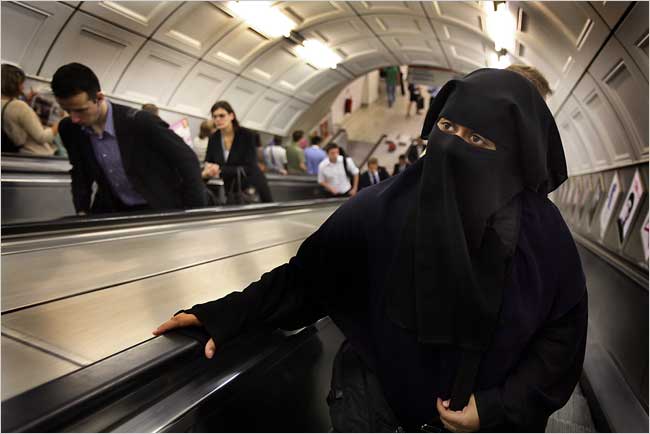
There seems to be a fundamental cultural problem at the heart of the niqab debate. Why did France decide to 'ban the burqa'? Why has a mother has been turned away from a parents evening for concealing her face? Let's discuss this, and feel free to disagree.

Yes, this is an old piece of news, but a very relevant issue and something that hasn't really been cropping up lately. It's something that needs greater discussion in my opinion.

It is not necessarily the refusal or the bans that have prompted me to write this article. It is more the failure to understand the culture involved with the face veil. Labels such as 'Muslim veil' place the blame on the entirety of Muslim culture. One may as well say Christians are homophobic. Furthermore, the constant referral to a burqa or burka is incorrect. The comedian Omid Dajili pointed this out on the BBC's One Show. The hosts named the veil a burqa, but it's a niqab; a face covering. The burqa is a complete covering of the body, including the eyes.

If you can't beat them...no pun intended.
I admit, it's a subtle difference, but it's the same kind of attitude that assumes Iraq is the same as Afghanistan or that Vietnam, China and Japan are all roughly similar. Sometimes we are not well informed, but we may as well be aware that we're not. The wisest man knows nothing and so on. There's a sense of ignorance, a gap in the average UK citizen's knowledge to allow them to create their own opinion.

As for the comments on that Daily Mail piece; admittedly I'm unsurprised that they're there, considering it's the Daily Mail after all. I'm not going to use them as a barometer for British opinion for obvious reasons, but there is the inevitable fact that some show the aforementioned lack of knowledge of the average citizen.

Can you accept penalisation of those who are already
supposedly suppressed?
Consider that the perfectly logical comment "she is no threat to society , an everyday women dressed according to her beliefs and the world has a problem to that! [sic]" has 12 downvotes. The less informed "She could have removed the face veil, as it's not required by her religion to wear the niquab [sic]" is incorrect, but has 8 upvotes. 


'Her religion' encompasses a vast array of interpretations, just like Christianity, Judaism or Hinduism. In her interpretation, it may not be possible to remove her veil. I'm not foolish enough to say upvotes on the comments section of a newspaper's website are a valid indication of widespread British opinion, but it makes you think.


While there is a possibility that it may be her husband's or society's requirement that some Muslim women, perhaps the one in question, wear the niqab, that's a whole other argument that I'm not going to discuss in this post. Let's try to stay focused on cultural clash and ignorance.


For every ignorant or hateful comment on something as simple as religious clothing though, there is one pointing out the everyday-ness of such dress, the hugely tolerant nature of the UK, the acceptability of such dress sense (minus the connotations of control) and so on. I hope that the UK can provide an example to the rest of the world that while some of us as citizens may not like something, we are a culture that is used to change, to flexing around influxes of new peoples.

"(Potentially) suppressed women are suppressed by a society that fears and pities them, asking questions about why they wear the niqab while vilifying them for doing so."

Equally one cannot skip around the argument forever. Can I be absolutely sure that in 100% of cases the burqa is used voluntarily? No. But why should something like this jeopardise a person's right to find out how their child is doing at school? Think about that; the UK media bombards those who wear the veil with questions about anonymity and suppression, in turn doing nothing more than amplifying those two demons. (Potentially) suppressed women are thus suppressed by a society that fears and pities them, asking questions about why they wear the niqab while vilifying them for doing so.

Indeed, we as a Western culture have very little moral standing to criticise the possible oppression of women in such a manner. In a society that hates imperfection, and constantly assails us with impossible high standards that we are visually expected to meet, where every visual medium - even the most recent - has a grim history of objectified and stereotyped women, can we comfortably criticise? Sharia Muslims may use the niqab, but Californians have Photoshop.


NB; I do not condone forcing any human being into any action. I understand there are hardline Muslims, as with any religion, but the focus of this blog post is on cultural clash.

I was at Silverstone this weekend, apologies for the late post.